

For decades, schools around the world treated academic performance and student wellbeing as two separate domains, one focused on grades, the other on emotions. But today’s research is clear:
Students learn better when they feel better.
And schools perform better when they prioritize both.
This understanding is at the heart of modern education, and it’s why leading institutions worldwide are shifting toward whole-school approaches that integrate wellbeing directly into academics. At Obelus, we call this approach The Integration Method, a practical, three-step framework that links learning outcomes with emotional health through our four interconnected pillars.
Here’s how it works.

Academic progress and wellbeing are inseparable:
✓ Students with higher wellbeing demonstrate better memory, engagement, motivation, and problem-solving.
✓ Schools with strong wellbeing cultures experience fewer behavior issues and higher attendance.
✓ Teachers with strong wellbeing skills create more effective and supportive classrooms.
The Integration Method ensures that academic and wellbeing systems support each other, not compete for attention.
Step 1: Assess What Matters (Data Before Decisions)
The first step is understanding the whole picture.
Schools often make academic or wellbeing decisions based on assumptions, without evidence. A proper integration model starts with measuring both learning performance and wellbeing indicators.
This includes:
✓ Reading comprehension, numeracy, and STEAM skills
✓ Emotional wellbeing, confidence, resilience, and engagement
✓ Student attitudes toward school, peers, and learning
✓ Teacher wellbeing and leadership capacity
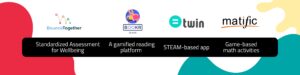
Tools like BounceTogether: Standardized Psychometric Assessment for Wellbeing, and academic platforms such as BOOKR Kids: Digital Library and Reading App, Matific: Gamified Math App, and Twin Science & Robotics: STEAM for Sustainability App generate this crucial data.
You can’t improve what you don’t measure. Data reveals patterns, gaps, and strengths that would otherwise remain hidden.
Step 2: Connect Insights to Action (Academic + Wellbeing Intervention)
Once the school has clarity, the next step is to turn insights into targeted action.
1️⃣ Academic Interventions
Based on student performance data:
✓ Reading reinforcement groups
✓ Numeracy boosters
✓ STEAM challenges that build problem-solving
✓ Adaptive learning pathways
2️⃣ Wellbeing Interventions
Based on wellbeing survey data:
✓ Character strengths lessons
✓ Stress & resilience workshops
✓ SEL-based classroom routines
✓ Targeted support for students showing early risk indicators
3️⃣ Teacher Capacity Building
Trained teachers are the engine of integration. Professional programs from the University of Buckingham help educators build skills in:
✓ AI in education
✓ Pedagogical improvement
✓ Leadership
✓ Student wellbeing support
4️⃣ Unified School-Wide Initiatives
This includes:
✓ Wellbeing weeks connected to academic themes
✓ Cross-curricular SDG-focused projects
✓ Mentorship and pastoral care systems
✓ Community engagement and parent workshops
When academic and wellbeing actions are aligned, schools see improvement in both performance and school climate.
Step 3: Sustain and Elevate (Embedding the Four-Pillar Framework)
Integration is not a one-time project, it’s a continuous cycle.
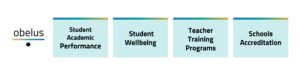
To sustain improvement, schools benefit from a structured framework that maintains quality and consistency. This is where Obelus’ four pillars work together:
🎓 1. Student Academic Performance Pillar
BOOKR Kids: Digital Library and Reading App, Matific: Gamified Math App, and Twin Science & Robotics: STEAM for Sustainability App build reading, math, and STEAM competencies. These platforms generate academic performance data that supports personalized learning.
💚 2. Student Wellbeing Pathway Pillar
BounceTogether: Standardized Psychometric Assessment for Wellbeing and Amazing People Schools: Character Strength–Based Approach strengthen emotional intelligence, resilience, and character. The MEL Unit guides schools in interpreting wellbeing data and planning interventions.
👨🏫 3. Teacher Training Pillar
Educators receive up-to-date training through the University of Buckingham in areas like:
✓ Pedagogy
✓ Instructional leadership
✓ AI integration
✓ Wellbeing leadership
This ensures staff can deliver both academic and wellbeing programs effectively.
🏆 4. School Accreditation Pillar
Gatehouse Awards (General, STEAM, and Wellbeing Accreditation) provide schools with:
✓ External validation
✓ A structured improvement framework
✓ Global recognition
✓ A benchmark to maintain quality year after year
Accreditation reinforces the integration cycle, ensuring sustained progress and institutional excellence.
Putting It All Together: The Integrated School Model
The Integration Method transforms schools into ecosystems where:
✓ Students thrive academically and emotionally
✓ Teachers feel supported and empowered
✓ Leadership decisions are evidence-driven
✓ Parents trust the school’s holistic approach
✓ Accreditation strengthens long-term growth
This is the future of education, one where wellbeing and learning are not two separate goals, but one unified mission 🌱
Academic success cannot stand alone. Wellbeing cannot stand alone.
Schools need an integrated system that connects data, interventions, professional development, and quality assurance. The Integration Method makes this possible, and achievable.
Ready to Transform Your School?
Explore our full framework at www.theobelus.com/portfolio or reach out to us at info@TheObelus.com to start a conversation with our team.